
What Employers Need To Know In 2026-27
Salary confidence is low and talent remains mobile: Deep insights from our latest Salary Guides
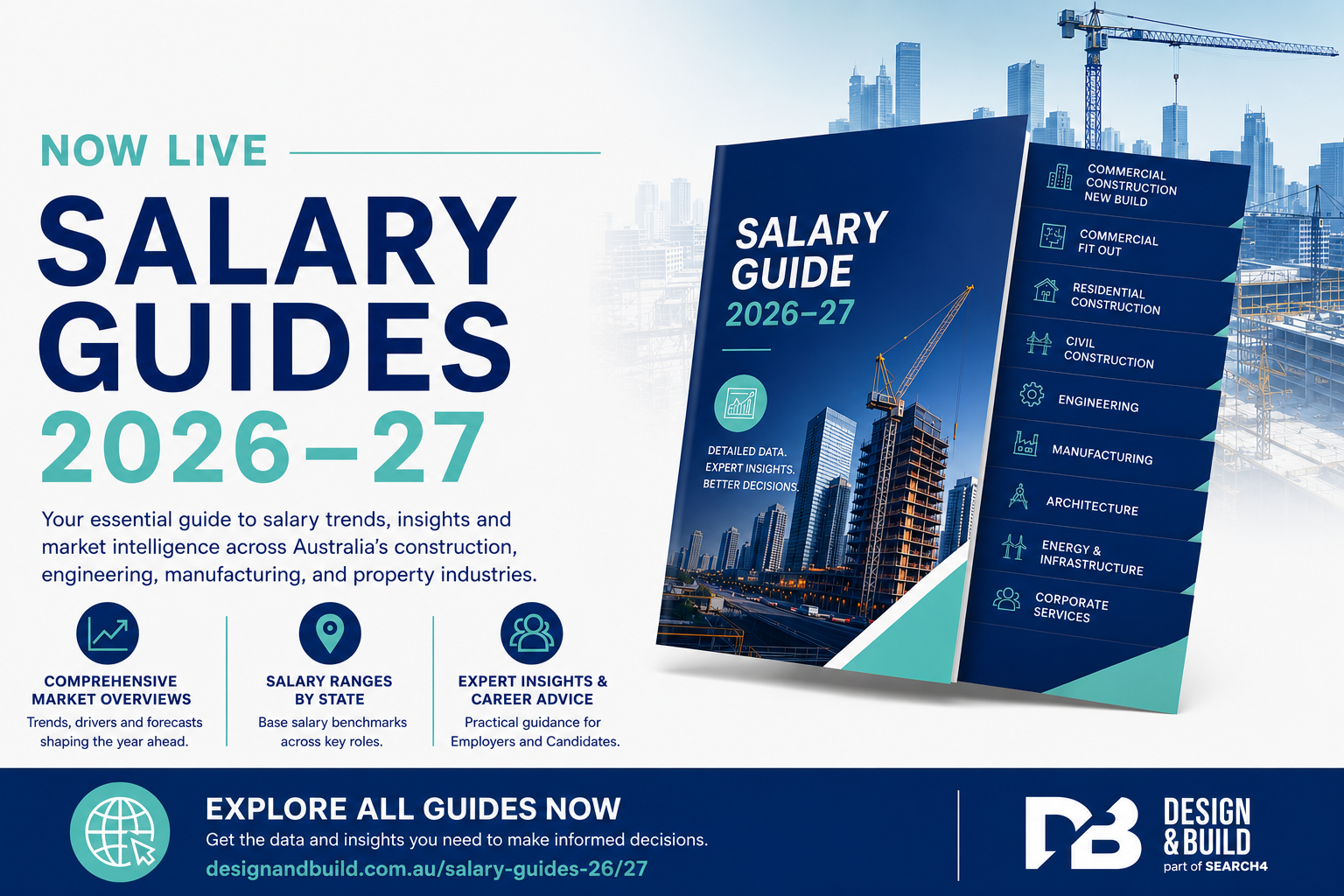
D&B's latest salary data reveals a workforce that may be reasonably satisfied, but remains highly receptive to new opportunities. For employers, competitive pay is now the starting point - not the complete retention strategy.
Australia's Construction, Engineering, Manufacturing, Architecture and Property employers are entering 2026-27 with a complex talent challenge. Professionals do not necessarily need to be unhappy to consider leaving.
Across D&B's latest salary survey data, 60% of respondents described themselves as satisfied or very satisfied in their current roles. At the same time, 81% were either actively looking for a new opportunity or said they would be willing to listen to an offer.
Only 19% said they were not looking and had no interest in hearing about other roles.
That tension between satisfaction and mobility is one of the clearest messages in this year's data. Employers cannot assume that a positive engagement result, a recent salary increase or a low resignation rate means their workforce is secure.
Pay confidence is divided almost equally three ways
34% of respondents believe they are being paid the current market rate, while 32% believe they are not being paid at market, and another 34% are unsure.
That uncertainty is important. An employee does not need to be convinced that they are underpaid to become a retention risk. Simply being unsure can make them more receptive to external salary information, recruiter conversations and competing offers.
The data also shows considerable expectation around future remuneration. Just over half expect a pay rise in the next financial year, while another third remain unsure. Only 15% do not expect an increase.
Recent salary movement has also been uneven. Approximately 47% received an increase in the past year, while 41% have not received an increase from their current company. Among respondents who reported a valid percentage increase, the median was 5%.
For employers, the message is not that every employee requires an immediate salary adjustment. It is that salary decisions - and the reasoning behind them - need to be transparent, evidence-based and communicated before employees begin benchmarking themselves through the external market.
A pay rise is not, by itself, a retention strategy
One of the more surprising findings is that employees who recently received an increase remain highly mobile.
Among those who received a pay rise in the past year, 81% were still actively looking or willing to consider another opportunity. Even among respondents who believe they are currently paid at market, 73% remained open to offers.
Job satisfaction reduces active job searching, but it does not remove market interest. More than half of respondents who described themselves as very satisfied would still listen to an opportunity.
This indicates that salary reviews need to sit within a broader retention strategy. Employees also evaluate career development, leadership, flexibility, project exposure, culture, commute and the future value of staying with an organisation.
A salary increase may address an immediate concern. It does not necessarily answer the longer-term question: What will my career look like here?
Salary remains the leading reason to move - but sector differences matter
When respondents were asked what would make them most likely to consider a new job offer, 48% selected better salary.
Flexible working arrangements were the second most common answer at 18%, followed by a promotion or new role at 12%, better culture and values at 10%, and a better location or commute at 7%.
However, the balance changes materially between sectors.
Better salary was particularly dominant in:
• Manufacturing, where it was selected by 66%
• Commercial Construction Fit Out, at 63%
• Engineering, at 59%
• Commercial Construction New Build, at 53%
Flexibility carried greater weight in Corporate Services, Architecture & Interiors, and Energy & Infrastructure, where approximately one-quarter of respondents selected it as their main reason to consider a move.
Civil Construction presented a more balanced picture. Salary remained the largest factor, but promotion, flexible work, location and company culture all attracted meaningful interest.
This reinforces the importance of a sector-specific employee value proposition. A reward package designed for an office-based corporate employee will not necessarily resonate with a site manager, engineer, architect or FIFO professional.
Benefits need to reflect how people actually work
The benefits ranking produced another important distinction.
Remote work was the benefit most frequently ranked first across the combined response base. However, company vehicle was the most consistently high-ranked benefit overall, appearing near the top of respondents' rankings more often than any other benefit.
This was driven heavily by the construction sector. Across construction respondents, 78% placed company vehicle within their three most important benefits.
By contrast:
• In Architecture and Property, 58% ranked remote work first
• In Corporate Services, 44% ranked remote work first
• In Engineering and Energy, remote work was the most common first choice, while company vehicle and health insurance also ranked strongly
The takeaway is not that every employer needs to offer remote work or a company vehicle. It is that benefits should be relevant to the employee's role, working environment and personal circumstances.
A generic benefits package can appear comprehensive while still failing to address the factors employees value most.
Experienced talent is changing employers.
The response base was highly experienced. Approximately 64% had at least ten years of total industry experience.
Despite this, half had been with their current organisation for no more than two years, and a similar proportion had been in their current role for no more than two years.
At the same time, 69% said they had never been promoted by their current employer. Only around one in ten had obtained their current role through an internal promotion.
Taken together, these results suggest that many experienced professionals may be finding their next level of responsibility by changing employer rather than progressing internally.
For employers, this creates both a risk and an opportunity. Organisations that can offer clear career pathways, expanded responsibilities and visible development opportunities may be able to retain experienced employees who would otherwise look externally for their next step.
Career progression also needs to be concrete. General statements about future opportunity are unlikely to be enough. Employees increasingly expect to understand what progression looks like, what is required to achieve it and when that conversation will occur.
Sector performance cannot be judged using one measure
The sector comparisons demonstrate why employers should avoid relying on a single workforce metric.
Engineering respondents reported the most recent salary activity, with 70% having received an increase in the past year. Nevertheless, 82% were actively looking or open to offers.
Civil Construction had the strongest market-rate confidence, with half believing they were paid competitively. Yet 86% remained active or open - the highest level among the larger sector groups.
Commercial New Build recorded strong satisfaction, at 72%, but 80% would still consider another opportunity.
Architecture & Interiors had comparatively low recent salary activity and limited access to bonuses, while 83% remained open to the market.
Residential Construction showed weaker promotion and bonus signals, with 80% reporting that they had never been promoted by their current employer and 74% reporting no bonus structure.
The lesson is that salary increases, satisfaction, bonus access and retention should be assessed together. No single measure provides a complete picture of workforce risk.
Representation remains uneven
Across the combined response base, 76% identified as men and 23% as women, while 1% preferred not to say.
Representation varied significantly by sector. Women accounted for approximately half of Architecture & Interiors responses and formed the majority in Corporate Services. By contrast, women represented between 9% and 14% of responses across Commercial New Build, Civil Construction, Energy & Infrastructure and Engineering.
These figures describe the survey response base rather than the complete industry workforce, but they still illustrate how uneven the talent pipeline remains.
Women in the survey were also more likely to identify flexible work as the main reason they would consider another role and were substantially more likely to rank remote work as their most important benefit.
Sector composition influences these results, but the wider implication remains relevant: flexibility, transparent progression and inclusive working practices are not simply employee benefits. They can directly affect an organisation's ability to attract from a broader talent pool.
What should employers do next?
The data points to several practical priorities for 2026-27.
Employers should benchmark remuneration at the level of the individual role, location and sector - not rely solely on broad national averages. Salary review processes should be clearly communicated, including when reviews occur and how decisions are made.
Benefits and flexibility should be tailored to how different employees work. A site-based construction professional, a corporate employee and a consulting engineer are unlikely to value the same package in the same way.
Career progression should also be made visible. Employees need to understand the pathway from their current position to the next, including the skills, performance expectations and opportunities required to progress.
Most importantly, employers should recognise that the passive candidate market now extends deep into their existing workforce. Employees can be satisfied, recently rewarded and still willing to consider the right opportunity.
A competitive salary may start the conversation. Clear progression, credible flexibility, strong leadership and a relevant employee proposition are increasingly what determine whether someone stays.
Our 2026-27 Salary Guides bring together current salary ranges and deeper workforce insights across our specialist markets, helping employers benchmark their teams and make more informed attraction and retention decisions.
For a personalised consultation on the best strategy for your business, please get in touch.